'god fearing', by Anabela Machado
I.
When I was a little girl, I had this pretty doll, with corn colored hair and a pink dress with a matching hat. She was eternally in prayer position, fabric hands pressed together. If you pushed a button, she would recite the Our Father, a childish voice in the middle of static. I don’t remember who gave her to me. I wasn’t raised in church, God was a mysterious name that had no meaning most of the time. Still, at night, I would press the button, putting my ear to the doll’s chest, listening to the voice reach the heavens. Soft and sure, a child infusing her prayer with hope.
As I grew older I decided to find the meaning of my life, what kind of divine watched me, if there even was such a thing. I forgot about the doll, and threw myself at the feet of every god I could find. I searched for holiness in the trees, in marble statues that would never answer me. I walked through pantheons, listening to the revenge and the hatred and the betrayal served by each of them, a cup of poison offered, tempting but still not right. I gave up for a time, sure that nothing truly existed, satisfied with the thought that once I died, everything that I was would be reduced to food for the worms. Then I tripped over the answer I had avoided all along.
II.
Here is the thing: Jesus had a mother.
I imagine in the beginning it felt like an honor, to be chosen for something like this. She was young and so hopeful, ecstatic by salvation that seemed so close. And when the baby was born, how could she not love him as hers? He was fully hers, for a time. Such a small and helpless child who needed her. She cared for him, fed him, clothed him, hugged him, prayed for him. A kind and beautiful boy, her son, her heart.
Isn’t that a tragedy?
Because at some point, she must have learned the truth. He knew, and he had to tell her, had to help her come to terms with it. It was his design, it was always supposed to happen. This was salvation, it should make you rejoice. But it tasted bitter, salty with tears. To see him like that, her soul, her child, bloody and weary, punished unfairly, the holy sacrificial lamb, willing and ready. Not her baby anymore, something else, more than. Parents should never have to bury their children, that’s not how things should go, but the unfairness of it bears down on us, heavy with meaning, and we must keep going, shoulders stooped from the weight. I think of this mother, with her divine child, a love that covered the world, and a willingness to suffer (both of them) for others. Maybe this is the only holy thing that matters, all the books fade into the background, meaningless in the face of such sacrifice. And still, isn’t this love? At its core, a love that subjects itself to horror for the salvation of others.
(They meet again, mother and child. After he defeats Death, she goes to him. They come back and she’s nowhere to be found, she’s with him again, holding him in her arms, like she did when he was a small baby, and when he was an adult, limp and lifeless, she held him still. And we pray to her, not like we do to God, but to seek comfort, like we would do with our own mothers, where love should always live).
What strikes me the most is that true love is rarely conventionally beautiful. It is a raw wound, on the way to healing. It is forgiveness even when you don’t deserve it, an openness that is humbling. It is a hand, that lovingly cleans and dresses you when you are at your lowest. It is the soft caress on your head, as you weep, ugly and convulsive.
III.
There is a beautiful place, far from town, where the divine meets the earthly. It’s not a church, but a type of shrine, right next to a water mine. It’s a little wooden construction, open and white, filled with candles and a holy image, right next to it cool and fresh water comes out from a pipe on the rock. People go there to pray and heal, drinking the water, tying promises on the green iron fence, nailing their results to a board. In this place, body chilled by the cold air, the cascading of water the only noise, you find Mary, you ask her to pray for you, to keep you in her thoughts. You want to be remembered by her, by this embodiment of motherly love.
My mother lights candles there sometimes, makes her own promises, prays. She asks for intercession from the holy mother. Hers is the hand that stretches towards us, offering guidance. In my heart of hearts, I believe she has helped us many times. I don’t know why. Maybe because her care is endless, her willingness eternal. Maybe the fact that I’m unsure is a sign I still have much to learn about the mysterious ways of all that is holy.
To be honest, I like not knowing.I like the uncertainty I always feel in that shrine, the sense that I’m near something far from my comprehension, beautiful but slightly out of focus. God is both a stranger and a friend, someone I can love and follow, but who’ll always bring awe. It is an incredibly familiar dream, but still foreign. There is comfort in it, a face I recognize but don’t know where to place it. To me, churches are places where time stands still, a frozen thing that fades into the background. I’m not at home in them, but I’m relieved, protected in some way.
Our Lady is always there, with a peaceful expression. The worst has passed, there are no more thorns to leave scars behind, now there is only lively greenery. A field of beauty, and she is at the center of it, the woman that birthed a man who is not a man. The divine winks at us from where it stands, a child that held the world. Mercy creeps up on us, an insistent thing. I go back to that place, where the sound of water fills my ears, and the light of the candles shines on the white tile, and I hope, and hope, and hope…
Anabela Machado is a 23 year old Brazilian writer. Her book, The Sacred Deer and other stories, was independently published on Amazon in the beginning of 2025. Her short stories (including God Fearing) can be found on Substack.
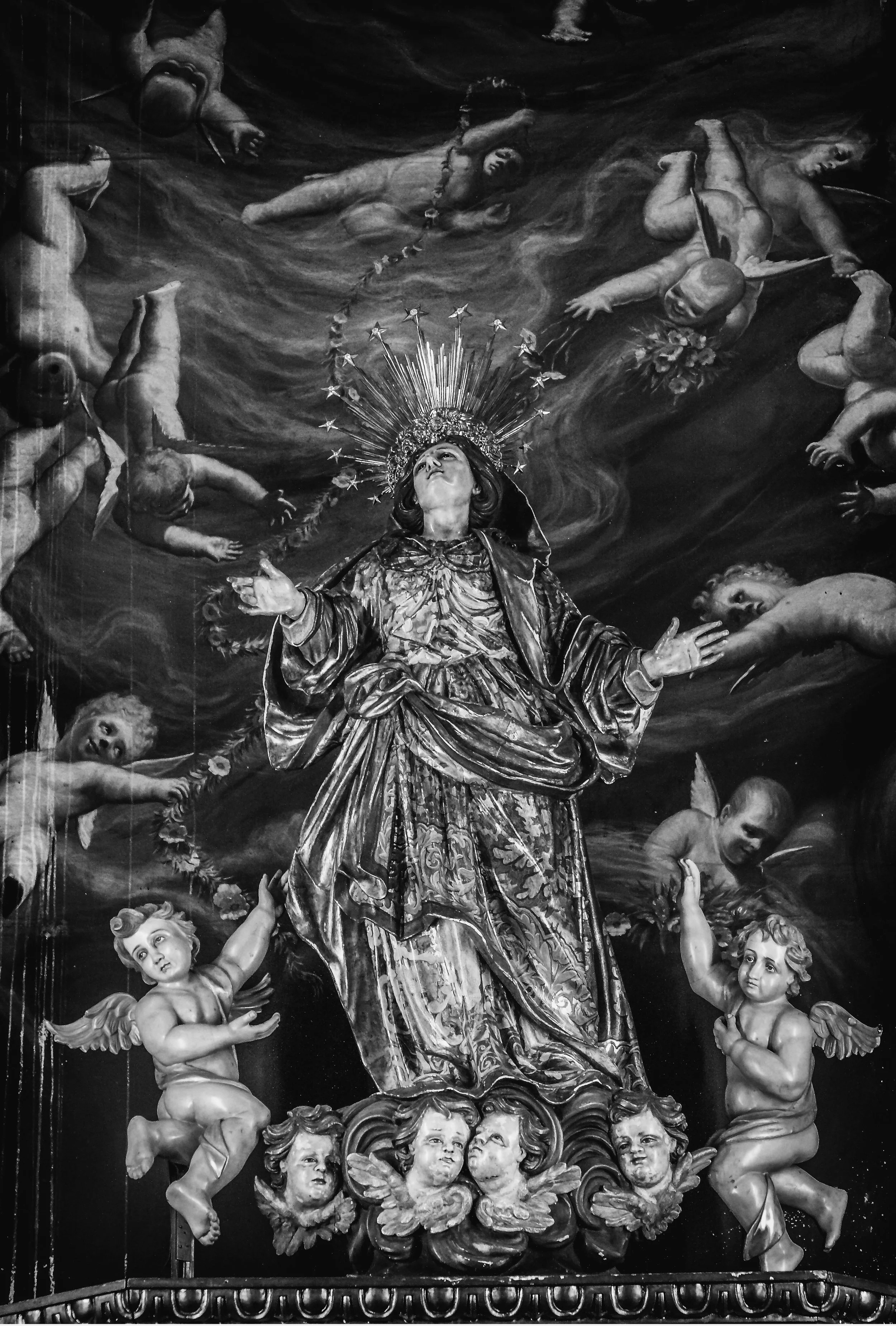
Photography by Carlos Mac (@carlosmacphotography)